
Writing in Light: The French Nouvelle Vague and the Cinema of Literary Revolution
In the dimly lit screening rooms of Paris's Cinémathèque Française during the early 1950s, a revolution was being plotted. Not with manifestos or barricades, but with notebooks, pens, and an insatiable appetite for cinema. A group of young critics (François Truffaut, Jean-Luc Godard, Éric Rohmer, Jacques Rivette, and Claude Chabrol) gathered daily to watch films, argue passionately, and dream of the movies they would make.
But cinema's seismic shift was already stirring. In 1956, a young photographer named Agnès Varda completed her self-funded debut La Pointe Courte, often considered the unofficial first film of the Nouvelle Vague. Shot on location in the fishing village of Sète with non-professional actors, Varda's film predated the movement's official arrival by three years. Her lack of cinematic training freed her to develop what she called "cinécriture" (writing on film), an abstract approach that prioritized stillness, location, and a literary quality that would resonate throughout the movement.
Also serving as an important precursor was Louis Malle's Elevator to the Gallows (1958, Criterion Collection Spine #335), a stylish thriller that critics note was "abusively attached to the Nouvelle Vague" and should be appreciated "at the crossroads of tradition and modernity." Malle himself never fully identified with the movement, and while his film's handheld camerawork and location shooting pointed toward the New Wave, it retained more classical elements than the radical departures soon to come from Godard and Truffaut. Crucially, Elevator to the Gallows introduced Henri Decaë's cinematography, featuring natural light and handheld cameras, which became foundational techniques for the movement.
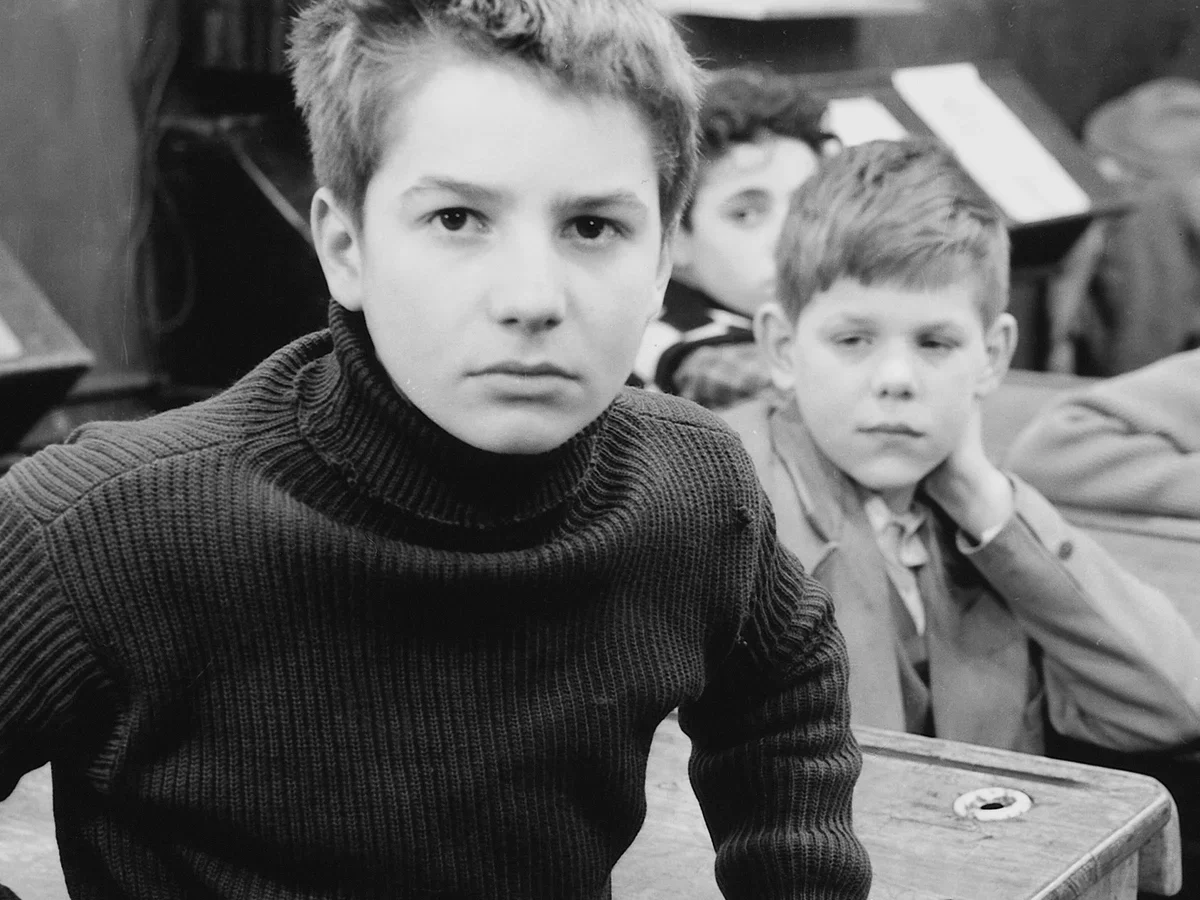
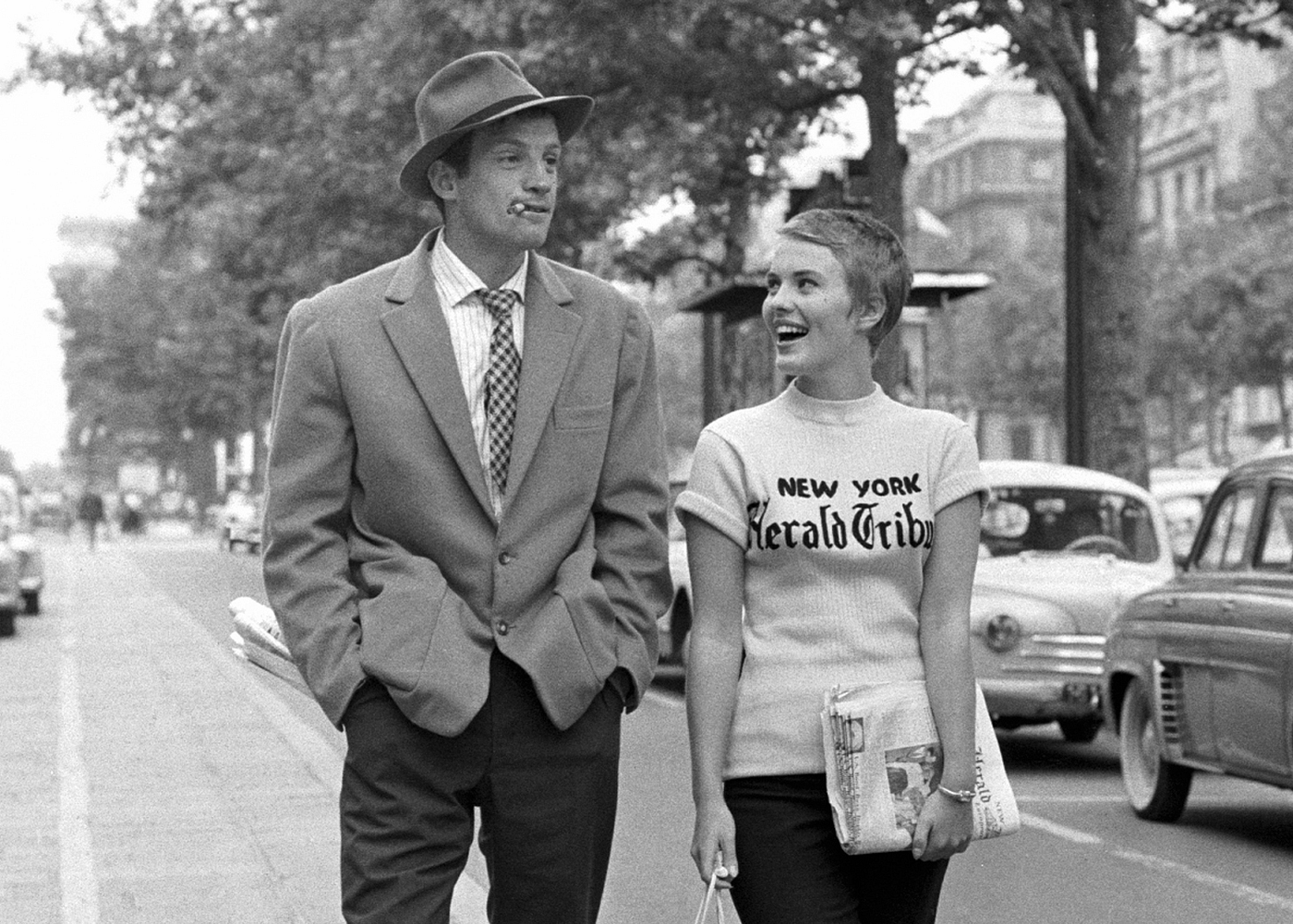
Yet it was in 1959 that the deluge truly began. François Truffaut's The 400 Blows (Criterion Collection Spine #5) and Jean-Luc Godard's Breathless (Spine #408) arrived like twin manifestos, announcing that French cinema would never be the same.
The Literary Soul of the Nouvelle Vague
The relationship between the Nouvelle Vague and literature was both complicit and revolutionary. These weren't merely filmmakers who happened to read. They were critic-cinephiles whose passion for novels, poetry, and literary experimentation fundamentally shaped how they approached cinema.
Alexandre Astruc had planted the seed in 1948 with his essay "The Birth of a New Avant-Garde: La Caméra-Stylo," arguing that the camera should function as a pen, allowing directors to write their thoughts directly on film. This wasn't metaphor. It was method. The Young Turks at Cahiers du Cinéma took Astruc's provocation seriously, reimagining cinema as a form of personal literature rather than industrial product.
Consider Truffaut's Jules and Jim (Spine #281), adapted from Henri-Pierre Roché's autobiographical novel. Truffaut didn't merely adapt the book. He absorbed it, rereading it obsessively until its rhythms became his own. The film's famous whip pans, freeze frames, and lyrical voice-over narration don't illustrate the novel so much as translate its literary consciousness into pure cinema. When Jeanne Moreau's Catherine suddenly stops and stares into the camera, we're experiencing cinécriture: the camera as pen, writing emotions that novels can only describe.
The Nouvelle Vague filmmakers staged their favorite fictions without necessarily adapting them literally. They recognized that literature, along with television, music, and other arts, actively intervened in cinema's representation of reality. Truffaut drew inspiration from Balzac's observational acuity, while Rivette incorporated theatrical structures into films that could run four hours or more.
Godard's Breathless opens with Jean-Paul Belmondo's Michel Poiccard reading the newspaper in bed. But the way Godard frames it, the act of reading becomes a performance, a pose borrowed from American crime novels and French existentialist texts alike. The film is stuffed with literary references: Faulkner, Rilke, Apollinaire. When Jean Seberg's Patricia interviews a famous writer (played by real-life author Jean-Pierre Melville), we're watching the Nouvelle Vague examine its own literary pretensions with ironic affection.
Les Cahiers du Cinéma: The Crucible of Revolution
The story of the Nouvelle Vague is inseparable from the story of Cahiers du Cinéma, the magazine where criticism became a call to arms. Starting in 1952, a new generation of critics appeared in its pages, soon nicknamed the "Young Turks" for their devotion to the Cinémathèque and their vehemence toward "la qualité française"(the bloated, literary, studio-bound films that dominated French cinema).
These young critics (Truffaut, Godard, Rohmer, Rivette, and Chabrol) weren't content to simply review films. They developed the politique des auteurs (auteur theory), which established the director as the sole creator of their film, calling into question the primacy of the screenplay. This wasn't merely academic theorizing; it was revolutionary praxis. By treating directors as authors, they elevated the act of filming to the status of writing, closing the gap between critic and filmmaker.
The intellectual architecture they built at Cahiers would directly scaffold their films. When Truffaut opened The 400 Blows with a long, unbroken shot following young Antoine Doinel through the streets of Paris, he was enacting the Cahiers dictum that mise-en-scène (how something is filmed) matters more than what is filmed. The politique des auteurs wasn't theory anymore. It was practice.
This move from criticism to directing was unprecedented. Never before had a generation of film critics collectively reinvented cinema based on their own critical principles. The treatment of directors as writers brought the filmmaker closer to the critic and the act of filming closer to writing, owing much to Alexandre Astruc's influential analogy.
Breaking Every Rule: The Nouvelle Vague's Technical Revolution
If the Nouvelle Vague had a manifesto, it might have read: "Forget everything you learned in film school." These filmmakers didn't just break rules. They gleefully smashed them, then filmed the debris with handheld cameras.
Godard's Breathless became the movement's technical manifesto. In 1959, Godard made abrupt cuts within the same sequence, creating jump cuts that disoriented viewers and drew attention to the artificial nature of film itself. He shot often in friends' apartments or yards, using shopping carts for tracking shots when proper dollies weren't available. Henri Decaë's cinematography (pioneered in Malle's Elevator to the Gallows (Spine #335) and refined throughout the Nouvelle Vague) used available light instead of expensive studio lighting, giving the films a documentary immediacy that traditional French cinema lacked.
The entire grammar of cinema was questioned. Truffaut's The 400 Blows concludes with cinema's most famous freeze frame: young Antoine Doinel reaches the sea, turns to face the camera, and the image stops, holding us in suspended time. That freeze frame wasn't just a stylistic flourish. It was a philosophical statement about cinema's ability to capture and preserve a moment of pure becoming.
In Agnès Varda's Cléo from 5 to 7, included in The Complete Films of Agnès Varda box set, the director structures the entire film in real time, following a pop singer through ninety minutes of anxiety as she awaits potentially devastating medical test results. Varda's use of natural Parisian locations, her refusal of dramatic lighting, and her willingness to let her camera simply watch: this was cinécriture in action, the camera writing reality rather than staging it.
The movement's technical innovations were inseparable from their ideological ones. By shooting on location with handheld cameras, using natural light, employing jump cuts and freeze frames, breaking the fourth wall, and allowing improvisation, these directors weren't just making cheaper films. They were democratizing cinema, proving that personal expression mattered more than production values.
The Obsessions of the Auteurs
Among the Nouvelle Vague directors, the range of obsessions was vast. Chabrol was the most unclassifiable, lacking Truffaut's reflective romanticism, Godard's displayed modernity, Rivette's quasi-mystical asceticism, or Rohmer's obsessive rigor. His bourgeois murder mysteries occupied their own strange space, simultaneously inside and outside the movement.
Truffaut and Godard represented two antithetical poles. Truffaut's films were interconnected tapestries reflecting his personal obsessions: women, the search for father figures, childhood, and couples. His work remained humanist, emotionally accessible, rooted in autobiography. Born in 1932, Truffaut spent his first years with a wet nurse and then his grandmother, as his parents had little to do with him. His childhood was marked by a difficult relationship with his mother and a search for father figures, most importantly André Bazin, the Cahiers co-founder who became Truffaut's mentor and surrogate father.
This personal history suffuses The 400 Blows. The class in English pronunciation revolves around a question: "Where is the father?" This phrase resonates both within the film (Antoine has never known his real father) and in Truffaut's life. The film is autobiography and exorcism, literature and cinema, criticism transformed into art.
Godard, by contrast, grew increasingly intellectual and political. His films became essays, arguments, provocations. If Truffaut asked "Where is the father?", Godard asked "What is cinema?" His work systematically deconstructed narrative conventions, challenging viewers to think rather than feel. Where Truffaut invited emotional identification, Godard demanded critical distance.
Yet both shared a cinephilic obsession: the belief that cinema was an art form equal to literature, painting, or music. Both had spent their youths in the darkness of the Cinémathèque, watching three, four, five films a day. That accumulated viewing informed every frame they shot.
Legacy and Global Influence
The discovery of French New Wave films abroad provoked reactions that rippled across continents. In Eastern Europe, particularly Poland, Czechoslovakia, and Hungary, filmmakers absorbed the Nouvelle Vague's stylistic freedoms and applied them to their own political contexts. The Polish Film School's Andrzej Wajda and the Czech New Wave's Miloš Forman both acknowledged debts to Truffaut and Godard.
In Brazil, Cinema Novo drew directly from the Nouvelle Vague, particularly Godard's political militancy. Directors like Glauber Rocha created films that were simultaneously Third World manifestos and stylistic experiments. In the Soviet Union, the Thaw cinema of the 1960s showed unmistakable New Wave influence, as directors like Andrei Tarkovsky reimagined what Soviet cinema could be.
Most significantly, the Nouvelle Vague touched the New Hollywood generation. The young Americans who would revolutionize 1970s American cinema (Arthur Penn, Dennis Hopper, Francis Ford Coppola, Martin Scorsese, Brian De Palma) all studied the French films religiously. Later, directors like James Gray and Quentin Tarantino would continue mining the New Wave's inexhaustible riches. Tarantino's Pulp Fiction is unthinkable without Godard's jump cuts and non-linear storytelling; Wes Anderson's entire aesthetic descends from Truffaut's whimsical humanism.
The Nouvelle Vague proved that cinema could be as personal as poetry, as intellectually rigorous as philosophy, as emotionally immediate as a diary entry. These filmmakers showed that you could love American B-movies and European art films simultaneously, that you could be playful and serious, that you could honor cinematic traditions while smashing them to pieces.
The Spirit Endures
The transformation of society and mores, the desire to transform cinema and break with the past: these were at the heart of the Nouvelle Vague. It wasn't an "artistic school" with a particular style but rather a spirit that took as many different forms as there were filmmakers to seize it.
That spirit (curious, rebellious, literary, cinephilic, democratic) remains cinema's most generous gift to itself. From Varda's pioneering La Pointe Courte through Malle's stylish precursor work to the explosive arrival of Truffaut and Godard, the movement proved that personal vision could reshape an entire art form.
Today, when a young filmmaker picks up a digital camera and shoots a feature film in their neighborhood, they're following the path the Nouvelle Vague cleared. When a director breaks the fourth wall or uses a freeze frame or structures a film around long, observational takes, they're speaking the language Godard, Truffaut, and Varda invented.
The next time you watch Elevator to the Gallows or The 400 Blows or Breathless or Jules and Jim on the Criterion Collection, remember: you're not just watching movies. You're witnessing the moment when a generation of bookish, argumentative, passionate young people proved that the camera could indeed be a pen, and that the pages they wrote would reshape cinema itself, one revolutionary frame at a time.
Further Reading and Viewing
Criterion Collection Releases:
Elevator to the Gallows (Louis Malle, 1958) - Spine #335
The 400 Blows (François Truffaut, 1959) - Spine #5
Breathless (Jean-Luc Godard, 1960) - Spine #408
Jules and Jim (François Truffaut, 1962) - Spine #281
The Complete Films of Agnès Varda - Box set including La Pointe Courte (1956) and Cléo from 5 to 7 (1962)
Essential Reading:
Neupert, Richard. A History of the French New Wave Cinema. University of Wisconsin Press, 2007.
Marie, Michel. The French New Wave: An Artistic School. Blackwell, 2003.
Truffaut, François. The Films in My Life. Simon & Schuster, 1978.
Godard, Jean-Luc. Godard on Godard. Da Capo Press, 1986.
de Baecque, Antoine and Serge Toubiana. Truffaut: A Biography. University of California Press, 2000.
Brody, Richard. Everything Is Cinema: The Working Life of Jean-Luc Godard. Metropolitan Books, 2008.
Varda, Agnès. Varda par Agnès (Varda by Agnès). Cahiers du cinéma, 1994.
Key Essays:
Astruc, Alexandre. "The Birth of a New Avant-Garde: La Caméra-Stylo" (1948)
Truffaut, François. "A Certain Tendency of the French Cinema" (Cahiers du cinéma, 1954)
Bazin, André. "On the Politique des Auteurs" (Cahiers du cinéma, 1957)
