
May '68: When Cinema Stopped the CANNES FILM Festival
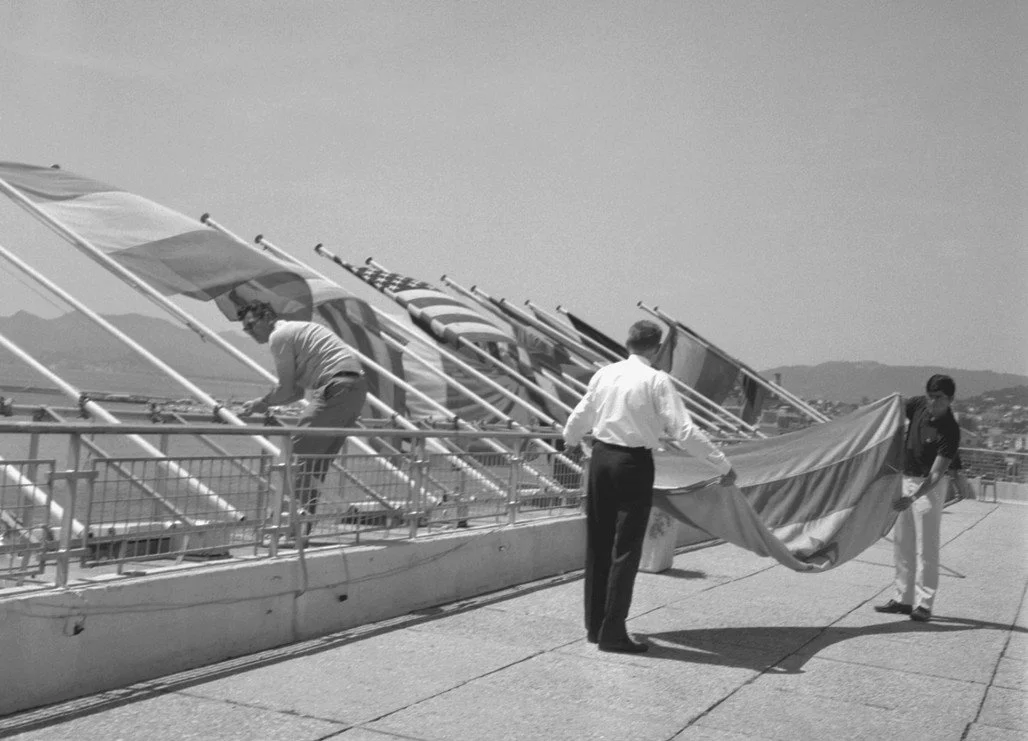
Interruption of the Festival - May 68 © P. Louis / AFP
On May 18, 1968, François Truffaut stood at the Cannes Film Festival in a tuxedo under the Mediterranean sun. Just nine years earlier, his film The 400 Blows had won the Best Director prize at this same event—the most glamorous gathering in world cinema. Now he was about to do something insane.
He was going to shut it all down.
Along with Jean-Luc Godard, Louis Malle, and a group of directors, Truffaut rushed the stage of the Palais des Festivals. Carlos Saura, the Spanish director, physically grabbed the bottom of the heavy red curtains to prevent them from opening. Godard shouted from the stage: "We're talking solidarity with students and workers, and you're talking dolly shots and close-ups! You're assholes!" Within hours, the 1968 Cannes Film Festival—mid-competition, films unreleased, prizes unawarded—was cancelled.
The moment crystallized something extraordinary: the collision between French cinema's artistic revolution and the political upheaval of May 1968. The directors who had changed how movies were made now believed they needed to change what movies were for.
The Dress Rehearsal: The Langlois Affair
The relationship between the Nouvelle Vague and literature was both complicit and revolutionary. These weren't merely filmmakers who happened to read. They were critic-cinephiles whose passion for novels, poetry, and literary experimentation fundamentally shaped how they approached cinema.
Alexandre Astruc had planted the seed in 1948 with his essay "The Birth of a New Avant-Garde: La Caméra-Stylo," arguing that the camera should function as a pen, allowing directors to write their thoughts directly on film. This wasn't metaphor. It was method. The Young Turks at Cahiers du Cinéma took Astruc's provocation seriously, reimagining cinema as a form of personal literature rather than industrial product.
Consider Truffaut's Jules and Jim (Spine #281), adapted from Henri-Pierre Roché's autobiographical novel. Truffaut didn't merely adapt the book. He absorbed it, rereading it obsessively until its rhythms became his own. The film's famous whip pans, freeze frames, and lyrical voice-over narration don't illustrate the novel so much as translate its literary consciousness into pure cinema. When Jeanne Moreau's Catherine suddenly stops and stares into the camera, we're experiencing cinécriture: the camera as pen, writing emotions that novels can only describe.
The Nouvelle Vague filmmakers staged their favorite fictions without necessarily adapting them literally. They recognized that literature, along with television, music, and other arts, actively intervened in cinema's representation of reality. Truffaut drew inspiration from Balzac's observational acuity, while Rivette incorporated theatrical structures into films that could run four hours or more.
Godard's Breathless opens with Jean-Paul Belmondo's Michel Poiccard reading the newspaper in bed. But the way Godard frames it, the act of reading becomes a performance, a pose borrowed from American crime novels and French existentialist texts alike. The film is stuffed with literary references: Faulkner, Rilke, Apollinaire. When Jean Seberg's Patricia interviews a famous writer (played by real-life author Jean-Pierre Melville), we're watching the Nouvelle Vague examine its own literary pretensions with ironic affection.
May Arrives: Paris Burns, Cannes Shines
The 21st Cannes Film Festival opened on May 10, 1968, with a restored 70mm version of Gone with the Wind. American actress and Princess of Monaco Grace Kelly hosted the opening ceremony. It was a grand, safe piece of Hollywood history—a deliberate choice of glamour and nostalgia.
But outside the bubble of Cannes, France was exploding.
On May 10, the same night Cannes opened, up to 30,000 students battled police in Paris's Latin Quarter in what became known as "The Night of the Barricades." The evening saw 367 people injured and 461 arrested, with cars burning in the streets.
Within days, the protests escalated. Two million French workers declared a general strike in sympathy with the students. By mid-May, seven to ten million people—students, workers, artists, intellectuals—had joined massive waves of strikes and protests that brought France to a virtual standstill.
Cannes was described as a "timeless, high-society, fun-loving bubble." While trains were blocked and factories occupied across France, the festival continued with champagne receptions and yacht parties. The contrast was obscene.
François Truffaut summed it up: "So to announce every hour that the Cannes Film Festival continues is just ridiculous."
Godard put it more bluntly: "We're talking solidarity with students and workers, and you're talking about dolly shots and close-ups. You're assholes."
The Curtain Comes Down
On May 13, the French Critics Association issued a statement calling on those at the festival to support the students in their "protest against the violent police repression." Festival founder Robert Favre Le Bret refused. As a concession, he offered to cancel parties and cocktails. It wasn't enough.
On May 17, in Paris, the États Généraux du Cinéma (Estates General of Cinema), a general assembly of cinema professionals, called for the Cannes Festival to be stopped.
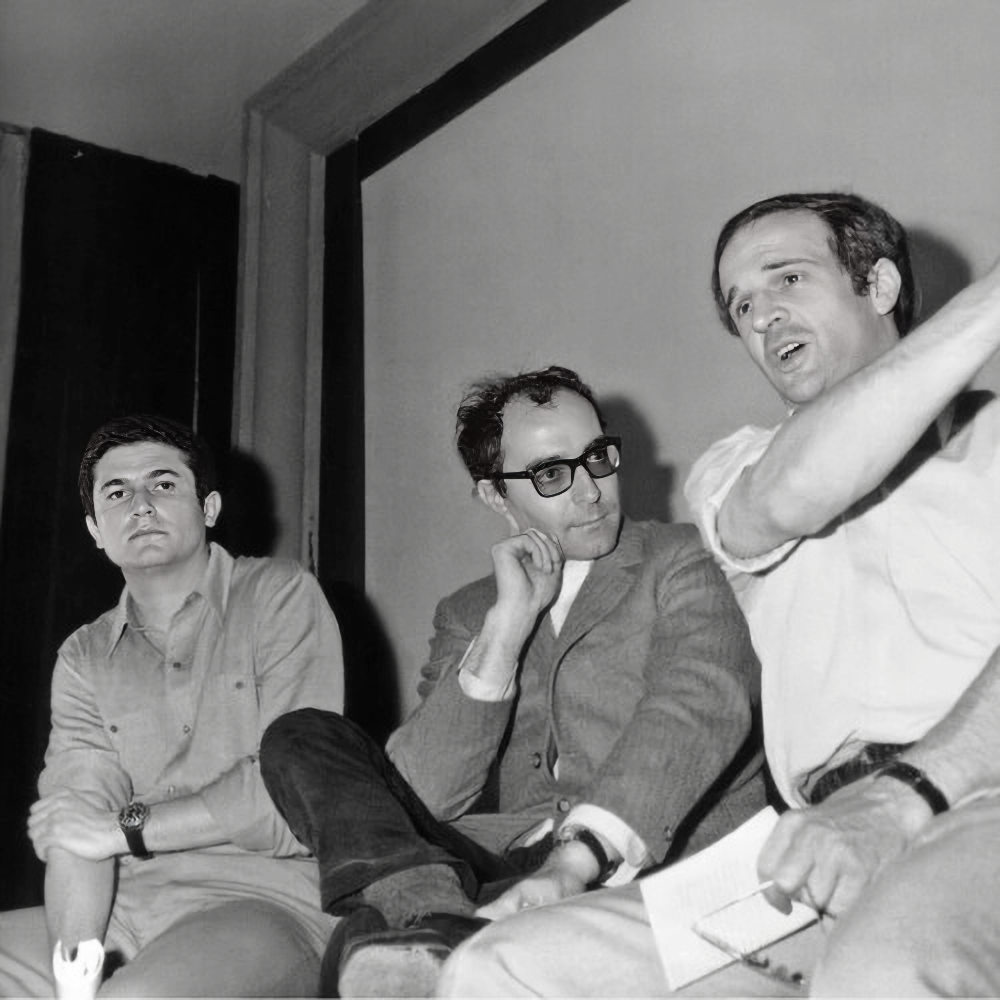
On May 18, Truffaut, Godard, Claude Lelouch, Jean-Gabriel Albicocco, actress Macha Méril, and jury members Louis Malle and Roman Polanski organized a press conference in the Salle Jean Cocteau at the old Palais Croisette. They announced that, in solidarity with the workers and students, the festival had to end.
Louis Malle, Monica Vitti, and Roman Polanski resigned from the international jury. Alain Resnais, Claude Lelouch, Carlos Saura, and Miloš Forman asked for the withdrawal of their films from competition.
Roman Polanski was skeptical—he considered these measures reminiscent of what Communists did in his native Poland—but ended up supporting the cancellation. He later said "people like Truffaut, Lelouch and Godard are like little kids playing at being revolutionaries."
But the festival tried to continue. When the screening of Carlos Saura's Peppermint Frappé was forced onto the schedule against the director's wishes, Saura and leading lady Geraldine Chaplin, along with Truffaut and Godard, tried to grab hold of the curtain in front of the screen to prevent it from opening.
There were fist fights. Godard lost his glasses while Truffaut took a tumble. French producer Jean-Pierre Rassam got punched right in the middle of the stage.
Eventually, Le Bret relented, reluctantly, and cancelled the festival on May 19, five days before its intended close.
Of the 28 films selected to compete for the Grand Prix, only 11 were screened. No prizes. No winners. The curtain had come down for good.
The Films That Never Were
The 1968 competition included several films that would become landmarks of 1960s cinema, though audiences wouldn't see them until months later, in an entirely different political context.
Carlos Saura's Peppermint Frappé was a psychological thriller starring Geraldine Chaplin. Alain Resnais's Je t'aime, je t'aime was a science fiction meditation on memory and time. Miloš Forman's The Firemen's Ball was a darkly comic allegory of Communist bureaucracy that would have likely won the Palme d'Or.
These films were casualties of history. When they finally premiered in regular commercial release, the revolutionary moment had passed, and they were received as works of art rather than political statements. The cancellation had transformed their meaning before anyone had even seen them.
The Aftermath: A New Festival Culture
The cancellation permanently changed Cannes and festival culture more broadly. On June 14, 1968, French filmmakers including Truffaut and Malle founded the Société des Réalisateurs de Films (SRF) with the mission of "defending artistic, moral and professional and economic freedoms of cinematographic creation."
In 1969, the SRF created the Directors' Fortnight (Quinzaine des Réalisateurs), a parallel section to the official Cannes selection. Led by Pierre-Henri Deleau, the Directors' Fortnight showcased more radical, experimental, and politically engaged films—works that the main competition might ignore.
The Directors' Fortnight became the launching pad for Martin Scorsese (Mean Streets, 1973), Werner Herzog (Aguirre, the Wrath of God, 1973), Chantal Akerman, Jim Jarmusch, and countless other directors who defined cinema in the decades that followed. It represented the institutionalization of the '68 spirit—a permanent space for dissent within the establishment.
Never again could major festivals present themselves as purely aesthetic events, divorced from politics. The creation of the Directors' Fortnight acknowledged that the main competition's selection process was inherently political, favoring certain kinds of films and directors over others.
The Rise of Political Cinema: Costa-Gavras and Z
If the 1968 Cannes cancellation represented the negative space—the festival that didn't happen—then the 1969 Cannes represented the positive assertion of political cinema's new legitimacy.
Costa-Gavras's Z premiered at Cannes in 1969 and won the Jury Prize (shared with Vojtech Jasný's All Good Countrymen). Star Jean-Louis Trintignant won Best Actor. The film was a thinly fictionalized account of the 1963 assassination of Greek politician Grigoris Lambrakis and the subsequent cover-up by right-wing military forces. With Greece under military dictatorship at the time of the film's release, Z was both a historical investigation and a contemporary protest.
The film opens with a title card that reads: "Any resemblance to real events and dead or living people is not a coincidence. It is INTENTIONAL."
Z demonstrated that political cinema could be commercially successful and artistically sophisticated. It was a thriller, a procedural, and a political exposé all at once. The film made Costa-Gavras a major director and showed that audiences wanted cinema that engaged with real-world power structures.
Z went on to win the Academy Award for Best Foreign Language Film—the first film ever to be nominated for both Best Picture and Best Foreign Language Film. It grossed $17 million in the United States. Roger Ebert made it his top film of 1969, writing: "It is a film of our time. It is about how even moral victories are corrupted. It will make you weep and will make you angry. It will tear your guts out."
The film's success at both Cannes and the Oscars in 1969—just one year after the festival cancellation—represented a stunning validation of the protesters' demands. Political cinema was no longer marginal. It was mainstream.
Watch it: Z is available as Criterion Collection Spine #491, with a beautiful restoration and extensive supplements about the film's production and political context.
Godard's Turn: The Dziga Vertov Group
While Costa-Gavras proved political cinema could succeed within the system, Godard took a more radical path. In the aftermath of May '68, he abandoned commercial filmmaking entirely.
In 1969, Godard formed the Dziga Vertov Group with Jean-Pierre Gorin, a younger filmmaker and Maoist intellectual. Named after the Soviet documentarian, the collective rejected individual authorship, narrative cinema, and bourgeois distribution. Their films would be signed collectively and shown to workers, students, and political organizations rather than in commercial theaters.
Between 1968 and 1972, the Dziga Vertov Group made a series of militant films:
Un film comme les autres (A Film Like Any Other, 1968): An analysis of May '68 made in its immediate aftermath
British Sounds (1969): An examination of class conflict at a British auto factory
Pravda (1969): A critique of Czech communism after the Prague Spring
Vent d'est (Wind from the East, 1970): A deconstruction of the Western genre as revolutionary allegory
Luttes en Italie (Struggle in Italy, 1971): An analysis of Italian factory workers
Vladimir et Rosa (1971): A satirical reimagining of the Chicago Eight trial
Tout va bien (Everything's Fine, 1972): A strike at a sausage factory, starring Jane Fonda and Yves Montand
Letter to Jane (1972): A 52-minute analysis of a single photograph of Jane Fonda in Vietnam
These films were dense, challenging, and often deliberately obscure. Godard believed that making films "politically" meant rejecting the pleasures of narrative cinema, which he saw as complicit with bourgeois ideology. The Dziga Vertov films used Brechtian distancing techniques, dense theoretical narration, and non-professional actors to prevent emotional identification.
Tout va bien (1972) was the group's most accessible work, featuring famous actors and a coherent narrative (sort of). The film depicts a strike at a French sausage factory, with management literally held hostage by workers. The factory set is a famous two-story cutaway that allows the audience to see all levels of the hierarchy simultaneously—a visual diagram of class structure.
The Dziga Vertov Group dissolved in 1972 after Letter to Jane. Godard and Gorin's relationship soured, and Godard's personal life changed dramatically. But the period represented one of cinema's most sustained attempts to create genuinely revolutionary film practice—cinema that didn't just depict revolution but enacted it in form and distribution.
Watch it: While not in the Criterion Collection, several Dziga Vertov Group films have been released by boutique labels and are available on streaming services like MUBI.
The Counter-Movement: Return to Entertainment
Not every post-'68 French film was a political manifesto. By the early 1970s, a counter-movement emerged: what French critics called "cinéma rétro"—films that retreated from political engagement into nostalgia, particularly for the World War II and Occupation periods.
Louis Malle's Lacombe, Lucien (1974) told the story of a French teenage collaborator with the Nazis—a morally complex character study that some critics attacked as fascist apologetics. Marcel Ophüls's The Sorrow and the Pity (1969), though made earlier, found commercial success in this period with its four-hour documentary examination of French collaboration.
François Truffaut's Day for Night (La Nuit américaine, 1973) was a love letter to classical filmmaking that explicitly rejected May '68's politicization of cinema. The film, which won the Academy Award for Best Foreign Language Film, celebrated the craft and artifice of movie-making without any political message beyond "Cinema is wonderful." For many May '68 veterans, this was a betrayal.
Truffaut defended himself: "I don't make political films. I make films." The statement captured a fundamental split within French cinema. Was cinema obligated to engage with politics, or was aesthetic achievement its own justification?
Watch it:
Lacombe, Lucien — Criterion Collection Spine #329
Day for Night — Criterion Collection Spine #769
The Fracture: Godard and Truffaut
The May '68 cancellation accelerated the breakdown of the friendship between Godard and Truffaut—two men who had once been allies in the New Wave revolution.
Truffaut's participation in the Cannes cancellation was genuine but limited. He loved cinema too much to sustain political militancy. He said later: "I love the galas. I love the tuxedos." For Truffaut, the cancellation was about defending Langlois and expressing solidarity in a moment of crisis. Once the crisis passed, he returned to making personal, humanistic films.
Godard, by contrast, saw May '68 as a turning point that demanded permanent transformation. Returning to commercial filmmaking would be a betrayal of the revolution. He committed himself to the Dziga Vertov Group's militant project.
In 1973, Truffaut wrote Godard a bitter letter attacking his work and ending their friendship. He accused Godard of being a "shit" who had "always behaved like a shit" and treated people badly while posturing as a revolutionary. The letter was devastating, personal, and final. They never reconciled. When Truffaut died in 1984, Godard did not attend the funeral.
The fracture between Godard and Truffaut symbolized a larger split in French cinema and culture. Could aesthetic achievement and political commitment coexist? Or did genuine political engagement require the sacrifice of beauty, pleasure, and humanism? May '68 had forced everyone to choose sides.
The Long Shadow: May '68's Legacy
More than fifty years later, the events of May 1968 and the Cannes cancellation continue to shape how cinema relates to politics.
The Directors' Fortnight survives as an institution, still showcasing radical and experimental work. Political cinema remains a viable category, with filmmakers like Ken Loach, the Dardenne Brothers, and contemporary activist documentarians carrying forward the tradition Costa-Gavras established.
But the utopian moment passed quickly. The revolution that seemed imminent in May 1968 never arrived. French President Charles de Gaulle won a landslide election in June 1968—a conservative backlash against the chaos. Most of the students who built barricades eventually became the technocrats and executives of the Mitterrand and Chirac eras.
Godard's career offers perhaps the clearest measure of May '68's contradictions. After abandoning the Dziga Vertov project, he spent the 1970s making increasingly obscure video essays with his partner Anne-Marie Miéville. In the 1980s and '90s, he returned to feature filmmaking with a series of difficult, poetic works that were neither commercial nor militantly political. His late masterpieces—In Praise of Love (2001), Film Socialism (2010), Goodbye to Language (2014)—are meditations on cinema's history and possibilities, haunted by the failure of May '68's promises.
Truffaut died in 1984, his legacy secure as a humanist filmmaker who believed cinema's highest calling was to illuminate human experience. Whether that stance was insufficient or essential remains a matter of debate.
What May '68 Means Today
The story of May 1968 and the Cannes cancellation poses questions that cinema still hasn't fully answered:
Can political cinema exist within commercial structures? Costa-Gavras proved it could, but at what cost? Does commercial success inevitably compromise political radicalism?
Is aesthetic achievement enough? Truffaut believed that making beautiful, humane films was a worthy goal in itself. Godard believed that beauty without political engagement was complicity. Both positions have merit; neither is obviously correct.
What is cinema's responsibility in times of crisis? Should filmmakers shut down festivals and make militant works? Or should they preserve cinema as a space of pleasure, beauty, and human connection?
The Cannes cancellation was the only time in the festival's history (outside of World War II) that it was stopped after opening. The moment represented a radical assertion: that in revolutionary times, art must transform or become irrelevant. But the revolution never came, and cinema continued—sometimes political, sometimes not, always contested.
The films remain. Z still thrills. Truffaut's 400 Blows still moves audiences to tears. Godard's Breathless still feels revolutionary. The Dziga Vertov films remain challenging documents of a particular historical moment. All of these works, preserved by institutions like the Criterion Collection, allow each generation to revisit the questions May '68 raised and to form their own answers.
May 1968 taught cinema that it could never again pretend to be apolitical. But it also demonstrated the limits of political certainty. The filmmakers who shut down Cannes were convinced they were on the right side of history. History had other plans.
Resources, Further Reading, Further Viewing
Essential Viewing
On May '68 and Cannes:
Cannes 1968 (Newsreel) — Available on the Criterion Channel, featuring footage of the festival shutdown
Post-1968 Political Cinema:
Z (1969) — Criterion Collection Spine #491
The Confession (1970) — Costa-Gavras's follow-up to Z, Criterion Collection Spine #759
State of Siege (1972) — Costa-Gavras's film about American intervention in Uruguay, Criterion Collection Spine #760
Missing (1982) — Costa-Gavras's Palme d'Or winner, Criterion Collection Spine #449
The Dziga Vertov Group:
Tout va bien (1972) — The most accessible Dziga Vertov film
Letter to Jane (1972) — Available on boutique labels
Wind from the East (1970) — Godard's Western deconstruction
The Retreat from Politics:
Day for Night (1973) — Criterion Collection Spine #769
Lacombe, Lucien (1974) — Criterion Collection Spine #329
Context Films (Pre-'68):
The 400 Blows (1959) — Criterion Collection Spine #5
Breathless (1960) — Criterion Collection Spine #408
Jules and Jim (1962) — Criterion Collection Spine #281
Recommended Books
On May 1968:
Ross, Kristin. May '68 and Its Afterlives. University of Chicago Press, 2002. — Essential analysis of May 68's cultural and political legacy
Seidman, Michael. The Imaginary Revolution: Parisian Students and Workers in 1968. Berghahn Books, 2004. — Revisionist account questioning some May 68 myths
On Godard:
Brody, Richard. Everything Is Cinema: The Working Life of Jean-Luc Godard. Metropolitan Books, 2008. — Comprehensive biography with extensive May '68 coverage
MacCabe, Colin. Godard: A Portrait of the Artist at Seventy. Farrar, Straus and Giroux, 2003. — Critical study examining Godard's philosophical development
On Truffaut:
de Baecque, Antoine and Serge Toubiana. Truffaut: A Biography. University of California Press, 2000. — Authoritative biography with detailed Cannes cancellation coverage
On Political Cinema:
Hillier, Jim (ed.). Cahiers du Cinéma: The 1960s—New Wave, New Cinema, Reevaluating Hollywood. Harvard University Press, 1986. — Essential anthology covering the magazine's evolution during May '68
Documentaries
Two in the Wave (2010) — Emmanuel Laurent's documentary about the Truffaut-Godard friendship and rupture
Godard, l'amour, la poésie (2007) — Documentary covering Godard's entire career with focus on political period
